"How China Could Counter U.S. Intervention in War Over Taiwan" - by CWP alum Joel Wuthnow
Has Beijing found a new “assassin’s mace” to keep the U.S. military out of a fight over Taiwan?
Ongoing debates over how China’s military would counter U.S. intervention often focus on precision strikes against U.S. forces in the Western Pacific. Indeed, some wargames assume that the People’s Liberation Army would throw the first punch. But such a move is not the only option available to China’s decision-makers. Other options include mounting a surprise invasion of Taiwan before the United States can mobilize, pressuring America’s allies to deny U.S. forces access to forward bases, or using strategic deterrence, which seeks to discourage Washington from defending Taiwan in the first place.
Of these options, pursuing strategic deterrence could prove most alluring for Beijing. The logic would be to convince the U.S. government that risks to the U.S. homeland, such as cyber attacks on power grids and telecommunications networks and even the specter of nuclear escalation, are too severe to contemplate. This strategy would leverage China’s expanding nuclear arsenal (and attendant nuclear signals), new intercontinental conventional missiles, space and cyber capabilities, and the belief that Beijing is inherently more resolved than Washington. Chinese leaders who embrace this thinking might conclude that a war could be limited, and thus, they might be more likely to opt for aggression.
To counter the challenge of Chinese strategic deterrence, the Trump administration should further integrate homeland defense with Indo-Pacific regional security. This would ensure unified planning to maintain deterrence both at home and abroad and would convince China that an end run around U.S. Indo-Pacific Command cannot succeed. The administration should also follow a strategic communications campaign to emphasize the grave risks of inadvertent escalation.
Wuthnow, Joel, "How China Could Counter U.S. Intervention in War Over Taiwan" (2025). Articles and Op-Eds. 6.
https://digitalcommons.ndu.edu/cscma-articles/6
Dr. Joel Wuthnow is a senior research fellow in the Center for the Study of Chinese Military Affairs within the Institute for National Strategic Studies at NDU. His research areas include Chinese foreign and security policy, Chinese military affairs, U.S.-China relations, and strategic developments in East Asia. In addition to his duties in INSS, he also serves as an adjunct professor in the Edmund A. Walsh School of Foreign Service at Georgetown University.
His recent books and monographs include China’s Quest for Military Supremacy (Polity, 2025, with Phillip C. Saunders), Sea Dragons: Special Operations and Chinese Military Strategy (Naval War College Press, 2025, with John Chen), Crossing the Strait: China’s Military Prepares for War with Taiwan (NDU Press, 2022, lead editor), and Gray Dragons: Assessing China's Senior Military Leadership (NDU Press, 2022). His research and commentary has also appeared in outlets such as Asia Policy, Asian Security, China Leadership Monitor, The China Quarterly, Foreign Affairs, Foreign Policy, Joint Force Quarterly, Journal of Contemporary China, Journal of Strategic Studies, Korean Journal of Defense Analysis, Naval War College Review, The New York Times, and in edited volumes.
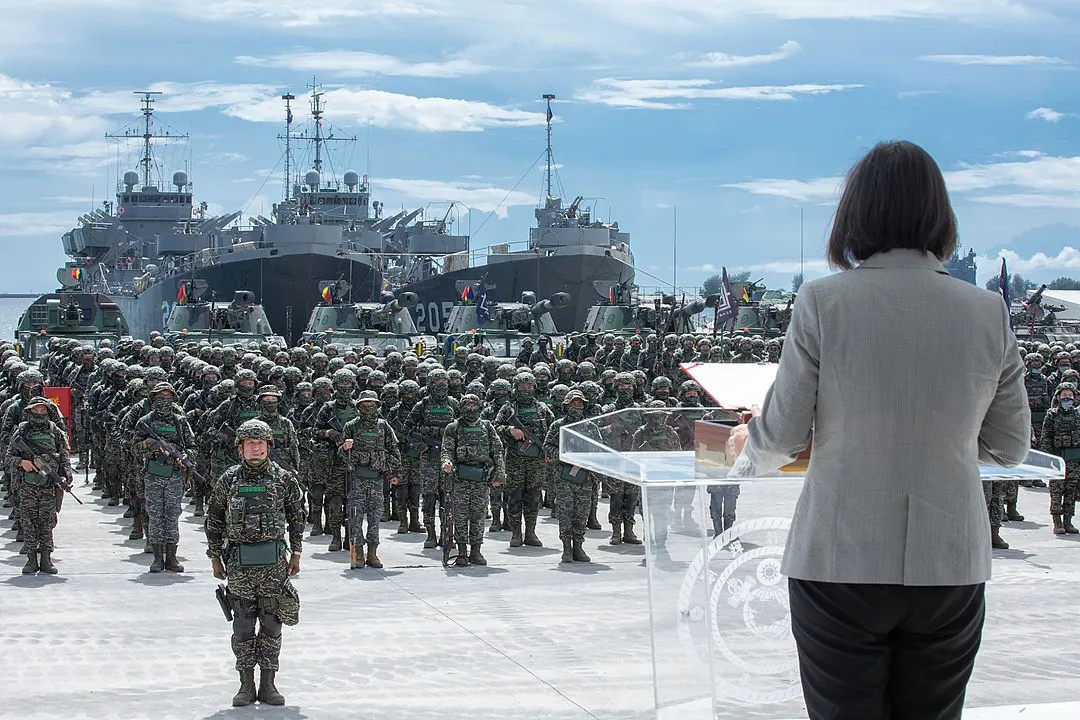
Photo Credit: Taiwan - Military with Tsai Ing wen Marine Corps battalion in Kaohsiung 2020_臺灣總統蔡英文校閱海軍陸戰隊九九旅步二營