"The Sino-Soviet Border Conflict of March 1969: Escalation, Command, and Intelligence on the USSR’s Far Eastern Front" - by CWP alum Joseph Torigian
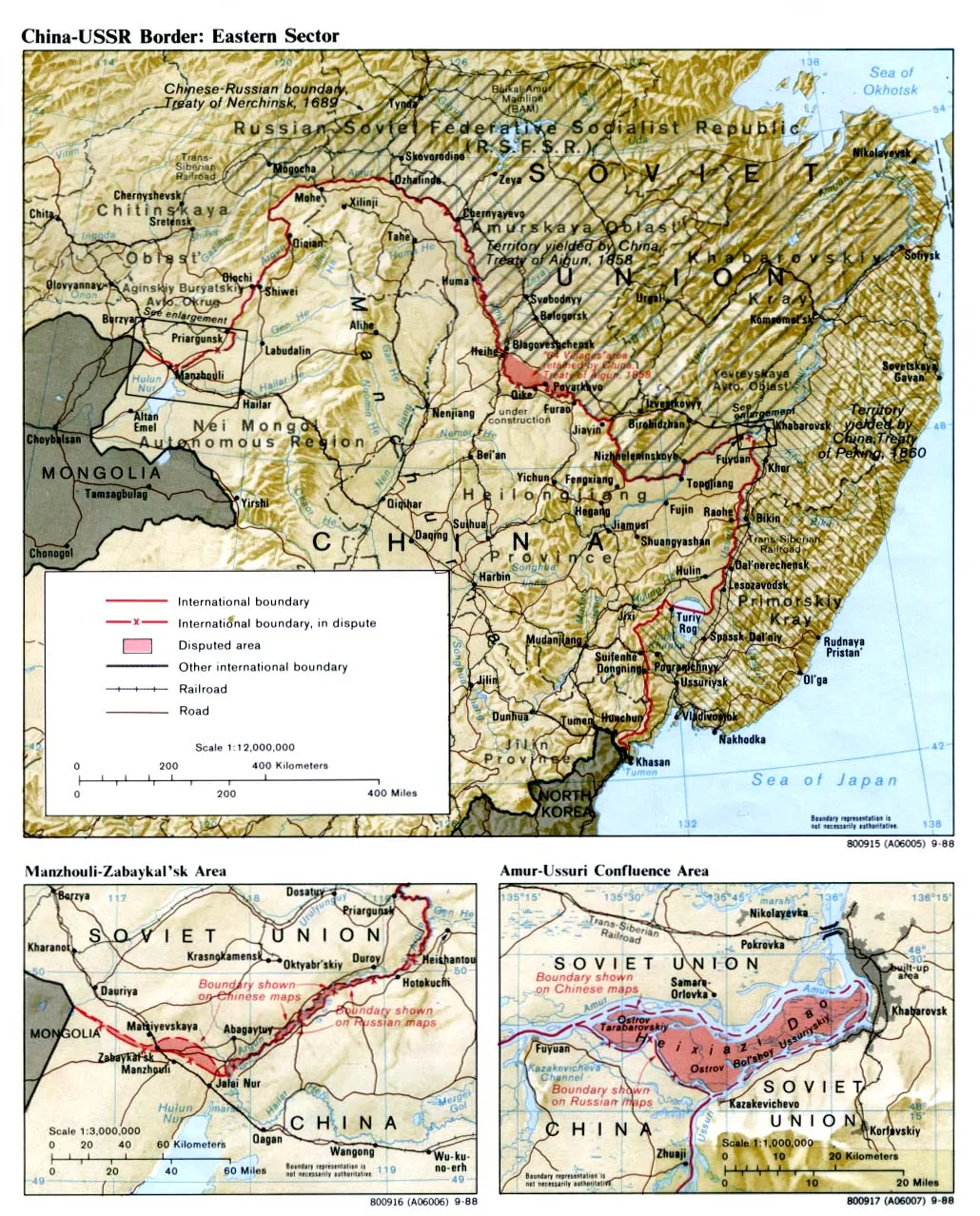
This article uses the March 1969 Sino-Soviet border clashes at Damanskii (Zhenbao) Island to explore the dynamics of military escalation, intelligence, and command and control. Drawing on recently declassified Soviet and Chinese archival documents and memoirs, the article reveals that Soviet leaders were deeply worried about escalation, at least initially. This fear, combined with systemic intelligence failures, command dysfunction, and ambiguous rules of engagement, left Soviet border guards unprepared for a meticulously planned Chinese ambush. Conversely, despite the internal chaos of the Cultural Revolution, Chinese forces were able to make extensive preparations and incorporate clear political goals into their military strategy. By analyzing the way combat decisions were made on both sides, the analysis here highlights the profound complexities frontline commanders face during crises between nuclear-armed powers.
Journal of Cold War Studies (2026) 28 (4): 79–157.
I study the politics of authoritarian regimes with a specific focus on elite power struggles, civil-military relations, and grand strategy. I use primary sources, rare books, and interviews to provide new accounts of historical milestones in two nations of crucial geopolitical importance: China and Russia. In particular, I investigate how leaders in those nations secure themselves against threats at home and abroad. My research agenda contributes to several fields and disciplines: international relations, comparative politics, security studies, history, and Chinese and Russian studies.
My first book, Prestige, Manipulation, and Coercion: Elite Power Struggles in the Soviet Union and China after Stalin and Mao was published with Yale University Press in 2022. My second book, The Party’s Interests Come First: The Life of Xi Zhongxun, Father of Xi Jinping was released with Stanford University Press in June 2025. It was a Financial Times Book of the Summer and an Economist Best Book of the Year So far. My current research agenda looks at nuclear weapons and the military-industrial complex in China and the Soviet Union during the Cold War.
I am an associate professor at the School of International Service at American University in Washington, a senior fellow at the Council on Foreign Relations, a 2026-2027 Wilson Center Research Fellow, and a center associate of the Lieberthal-Rogel Center for Chinese Studies at the University of Michigan. Previously, I was a Research Fellow at Stanford's Hoover History Lab, Stanton Nuclear Security Fellow at the Council on Foreign Relations, Postdoctoral Fellow at Princeton-Harvard’s China and the World Program, a Postdoctoral (and Predoctoral) Fellow at Stanford’s Center for International Security and Cooperation (CISAC), a Predoctoral Fellow at George Washington University’s Institute for Security and Conflict Studies, an IREX scholar affiliated with the Higher School of Economics in Moscow, a Fulbright Scholar at Fudan University in Shanghai, and a research associate at the Council on Foreign Relations. My research has also been supported by the Stanford Center on International Conflict and Negotiation, MIT’s Center for International Studies, MIT International Science and Technology Initiatives, the Critical Language Scholarship program, and FLAS.
My views on Chinese and Russian politics and history have appeared in media outlets such as the BBC, Washington Post, Bloomberg, Economist, Financial Times, New York Times, New Yorker, NPR, Wall Street Journal, CNN, and others. I have also published in general interest journals like Foreign Affairs and Foreign Policy.
Photo Credit: https://direct.mit.edu/jcws/issue
By Source: http://www.lib.utexas.edu/maps/middle_east_and_asia/china_ussr_e_88.jpg (Perry-Castañeda Library Map Collection)Originally from en.wikipedia; description page is/was here., Public Domain, https://commons.wikimedia.org/w/index.php?curid=2207913