"US’ Indo-Pacific Economic Bloc Irks China But It May Not Be All Bad For The Region" By CWP Alum Kai He
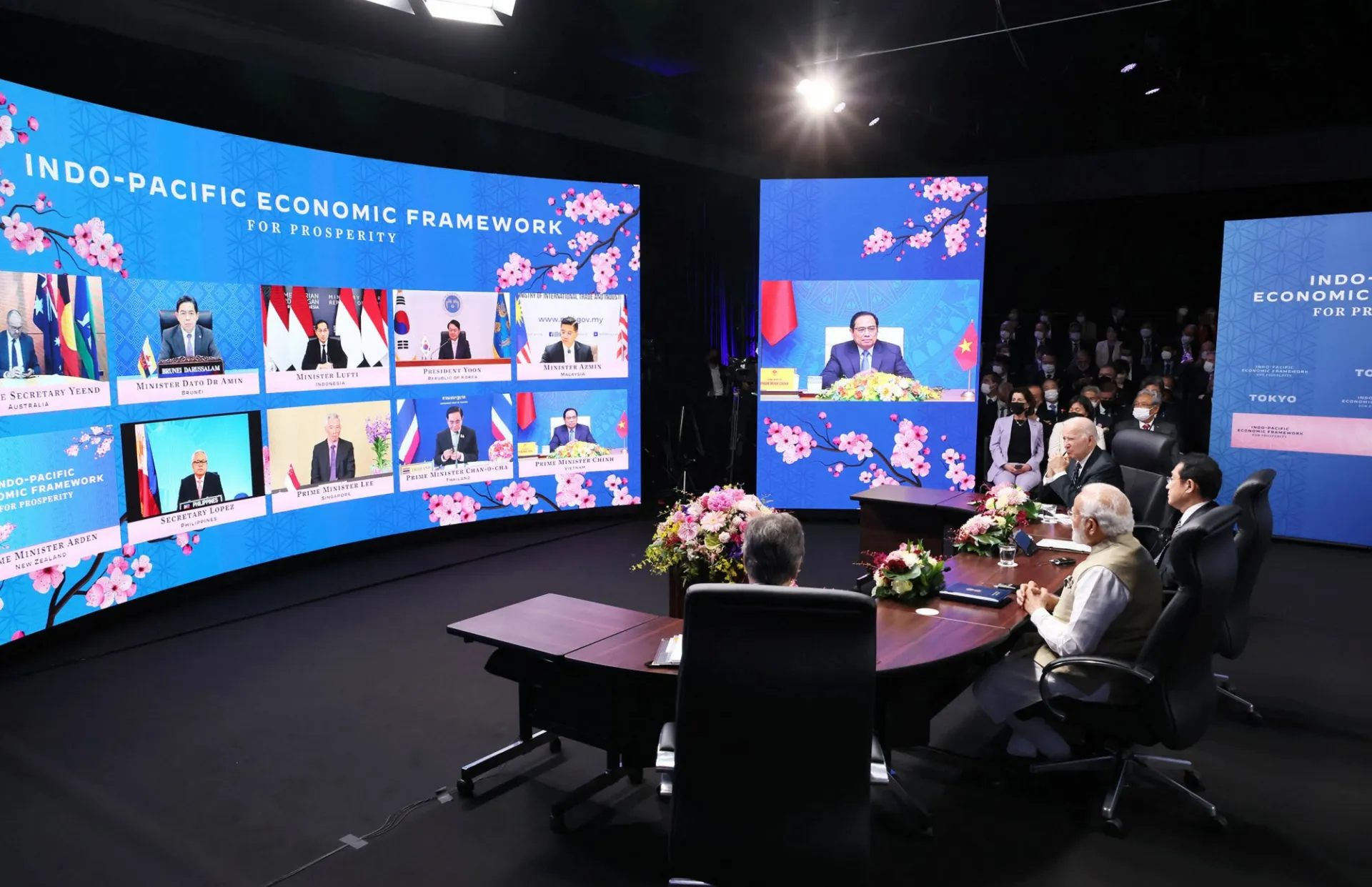
On May 23, US President Joe Biden announced the establishment of a new economic grouping, the Indo-Pacific Economic Framework (IPEF), including 13 inaugural members and accounting for about 40 per cent of the world’s GDP. China has not been invited. Given Biden’s claim that “we’re writing the new rules for the 21st-century economy”, it is clear that China is not only excluded but also targeted.
It looks like a win for the United States in this round of the institutional balancing game against China. Given former president Donald Trump’s withdrawal from the Trans-Pacific Partnership (TPP) some five years ago, the IPEF sends a clear message to the region that the United States is back in business.
Published: 3:30am, 3 Jun, 2022 - https://www.scmp.com/comment/opinion/article/3180033/us-indo-pacific-economic-bloc-irks-china-it-may-not-be-all-bad
Kai He is Professor of International Relations and Director, Centre for Governance and Public Policy, Griffith University, Australia. He is a visiting Chair Professor of International Relations at the Zhou Enlai School of Government, Nankai University, China (2018-2020). He is currently an Australian Research Council (ARC) Future Fellow (2017-2020). He was a postdoctoral fellow in the Princeton-Harvard China and the World Program (2009-2010).
He is the author of Institutional Balancing in the Asia Pacific: Economic Interdependence and China's Rise (Routledge, 2009), Prospect Theory and Foreign Policy Analysis in the Asia Pacific: Rational Leaders and Risky Behavior (co-authored with Huiyun Feng, Routledge, 2013), and China’s Crisis Behavior: Political Survival and Foreign Policy (Cambridge, 2016). He is a co-editor (with Huiyun Feng) of US-China Competition and the South China Sea Disputes (Routledge, 2018).His peer-refereed articles have appeared in European Journal of International Relations, European Political Science Review, Political Science Quarterly, Review of International Studies, Security Studies, International Studies Review, International Politics, Cooperation and Conflict, Contemporary Politics, Asian Survey, The Pacific Review, Journal of Contemporary China, The Chinese Journal of International Politics, Asian Security, Asian Perspective, Australian Journal of Political Science, Australian Journal of International Relations, International Relations of the Asia Pacific, Issues and Studies, Strategic Studies Quarterly, and East Asia.
He received several internationally competitive fellowships and grants, including the Princeton-Harvard China and the World Program Postdoctoral Fellowship (2009-2010), a Lynde and Harry Bradley Foundation Research Fellowship (2009-2010), an EAI fellowship (2011-2012) from the East Asia Institute in Seoul, an Asia Studies Fellowship (2012) from the East-West Center in Washington D.C., and visiting fellowships (2014/2017) from the S. Rajaratnam School of International Studies, Nanyang Technological University, Singapore, and a policy-oriented research grant from the Korea Foundation, South Korea. His current research projects are funded by the MacArthur Foundation, USA (2016-2018) and Australian Research Council (2017-2020). the Australian Research Council [grant number FT160100355] and the John D.and Catherine T. MacArthur Foundation [grant number 16-1512-150509-IPS] for their support.
Photo Credit: By 首相官邸 - https://www.kantei.go.jp/jp/101_kishida/actions/202205/23usa.html, CC BY 4.0, https://commons.wikimedia.org/w/index.php?curid=118291804