"Taming the Hegemon: Chinese Thinking on Countering U.S. Military Intervention in Asia" by CWP alum Joel Wuthnow
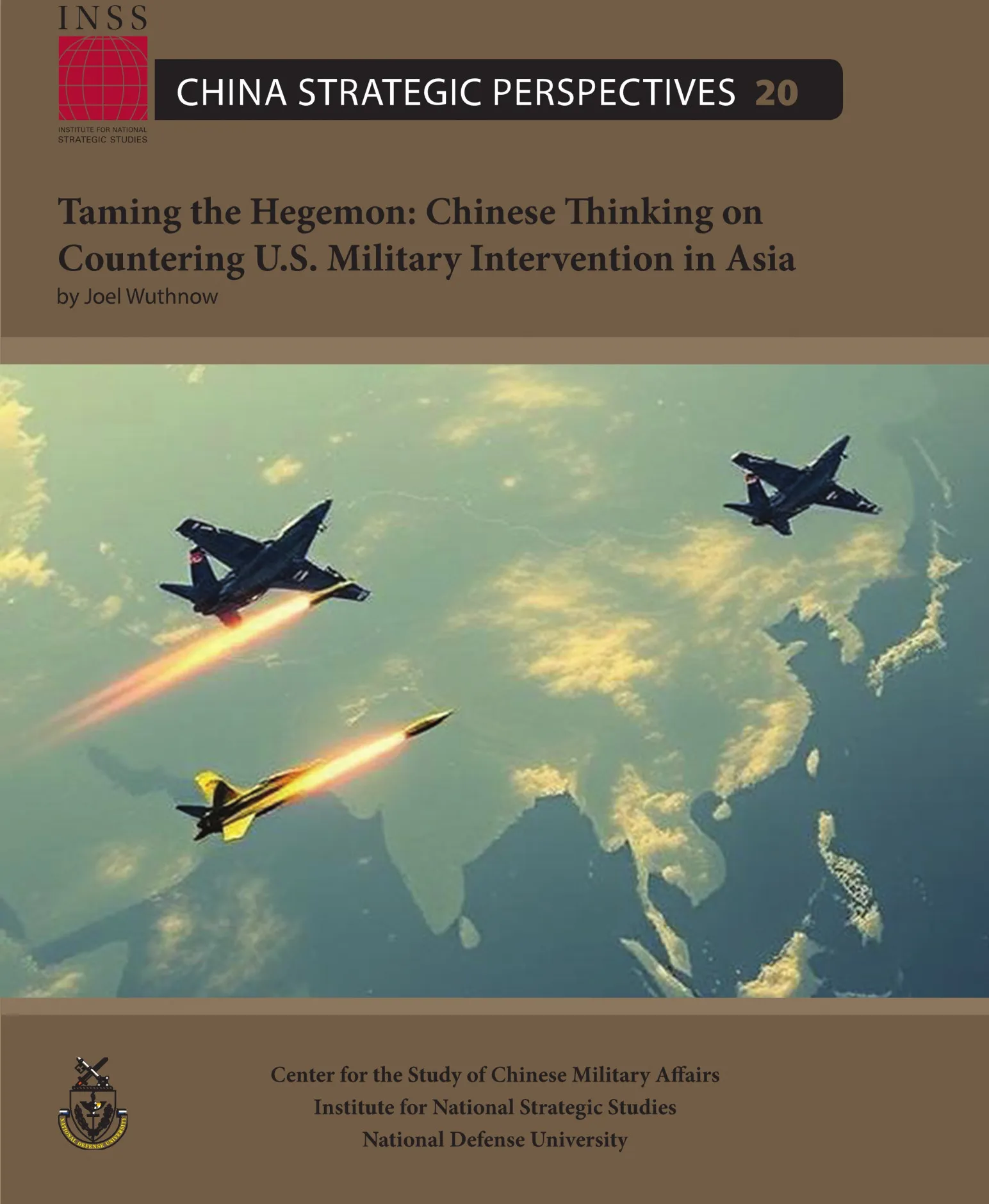
This report assesses recent Chinese thinking on countering U.S. intervention in Asia, specifically in a Taiwan contingency. Key findings include:
■ People’s Liberation Army (PLA) analysts assume U.S. forces will intervene in a Taiwan contingency, up to and including mainland strikes. This assumption, based on prudent military planning, has persisted for decades even as Chinese observers increasingly viewed U.S. power in a state of relative decline. It drives the PLA to advocate for careful preparation of counter-intervention options.
■ States in China’s position have historically relied on four options to counter third-party intervention in offensive campaigns: direct assault against intervening forces; deterrence actions against the third party’s political leadership; a fait accompli against the main target before the intervener can mobilize; and creation of strategic buffers between the attacker and the intervener.
■ PLA sources emphasize the options that require direct confrontation—direct assault and strategic deterrence of the United States—because they are the most decisive. The first relies on asymmetric warfare against key targets in the U.S. military system. The second leverages nuclear, conventional, and informational (space, cyber, and cognitive warfare) tools to pressure U.S. leaders to reject a recommendation to intervene. Both options are part of an effort to “deter and check” the “powerful enemy," which is a frequent euphemism for the United States.
■ The PLA has a different attitude toward escalation in these two options. A direct assault emphasizes military expediency. PLA scholars focus on precision strikes but also highcasualty attacks if necessary for the campaign plan. Deterrence relies on brinkmanship. The two Taiwan Strait crises of the 1950s are touted as examples of successful deterrence while managing risks.
■ The PLA appears less interested in the two indirect options because they cannot guarantee success. A fait accompli would be difficult due to strategic warning and a U.S. ability to respond quickly. Beijing will try to create strategic buffers by pressuring U.S. allies and partners to deny access, but those efforts could fail—and the U.S. military has options to intervene that do not rely on host nation support.
■ There is little deterrent value in shifting to a policy of strategic clarity regarding Taiwan’s defense since the PLA already anticipates U.S. intervention. Chinese President Xi Jinping appears to share that perspective. However, in the future, Chinese civilian leaders might hold more sanguine views on the likelihood of U.S. intervention than their military advisors, implying that messaging needs to be focused on both the PLA and the civilian leadership.
■ PLA deterrent signaling in the strategic domains (nuclear, space, and cyber) could create crisis instability even if the intent is to avoid escalation. Discussions with PLA interlocutors, including both senior-level discussions and crisis simulations, could help manage those risks.
■ Assuming Beijing has already made a strategic decision for war, the best U.S. response to Chinese deterrence is ambiguity and obfuscation. There are dangers in yielding to the deterrent threat, which would be tantamount to capitulation, or rejecting it out of hand, since Beijing would then pivot immediately to a direct assault. Entertaining but not committing to a favorable response from China’s perspective can buy time for U.S. forces to
begin dispersal into a wartime posture.
■ Deterring and defeating a PLA direct assault requires improvements to make U.S. targets less vulnerable while also exploiting the PLA’s own asymmetric disadvantages, especially its need to concentrate forces in the Taiwan Strait without guaranteed air and maritime supremacy. There are also opportunities to misdirect PLA resources into targets less essential for U.S. success.
■ The PLA may currently discount a fait accompli option, but that could change. The U.S. military should build and demonstrate capabilities that can slow an invasion despite reduced warning. U.S. messaging can also highlight failures of previous fait accompli attempts, including Russian president Vladimir Putin’s 2022 gambit to cloak the Ukraine invasion as an exercise and North Korean leader Kim Il Sung’s failure in the Korean War.
■ Contestation over U.S. access, basing, and overflight is part of the backdrop of strategic competition in Asia. Beijing will use all means at its disposal to block U.S. forces from using military facilities on allied territory and could have some success. U.S. planning for intervention should not assume that such access is guaranteed.
News | Sept. 15, 2025 Taming the Hegemon: Chinese Thinking on Countering U.S. Military Intervention in Asia
By Joel Wuthnow China Strategic Perspectives 20
Dr. Joel Wuthnow is a senior research fellow in the Center for the Study of Chinese Military Affairs within the Institute for National Strategic Studies at NDU. His research areas include Chinese foreign and security policy, Chinese military affairs, U.S.-China relations, and strategic developments in East Asia. In addition to his duties in INSS, he also serves as an adjunct professor in the Edmund A. Walsh School of Foreign Service at Georgetown University.
His recent books and monographs include China’s Quest for Military Supremacy (Polity, 2025, with Phillip C. Saunders), Sea Dragons: Special Operations and Chinese Military Strategy (Naval War College Press, 2025, with John Chen), Crossing the Strait: China’s Military Prepares for War with Taiwan (NDU Press, 2022, lead editor), and Gray Dragons: Assessing China's Senior Military Leadership (NDU Press, 2022). His research and commentary has also appeared in outlets such as Asia Policy, Asian Security, China Leadership Monitor, The China Quarterly, Foreign Affairs, Foreign Policy, Joint Force Quarterly, Journal of Contemporary China, Journal of Strategic Studies, Korean Journal of Defense Analysis, Naval War College Review, The New York Times, and in edited volumes.
Prior to joining NDU, Dr. Wuthnow was a China analyst at CNA, a postdoctoral fellow in the China and the World Program at Princeton University, and a pre-doctoral fellow at The Brookings Institution. His degrees are from Princeton University (A.B., summa cum laude, in Public and International Affairs), Oxford University (M.Phil. in Modern Chinese Studies), and Columbia University (Ph.D. in Political Science). He is proficient in Mandarin.
Photo Credit: https://ndupress.ndu.edu/Portals/68/Images/stratperspective/china/Screenshot%202025-09-15%20at%203_45_10PM.png?ver=YjhqROvhxz-z70zzYLRmvA%3d%3d