
"The Supreme Court’s Tariff Decision Could Affect Trump’s China Negotiations" - by CWP alum Zongyuan Zoe Liu
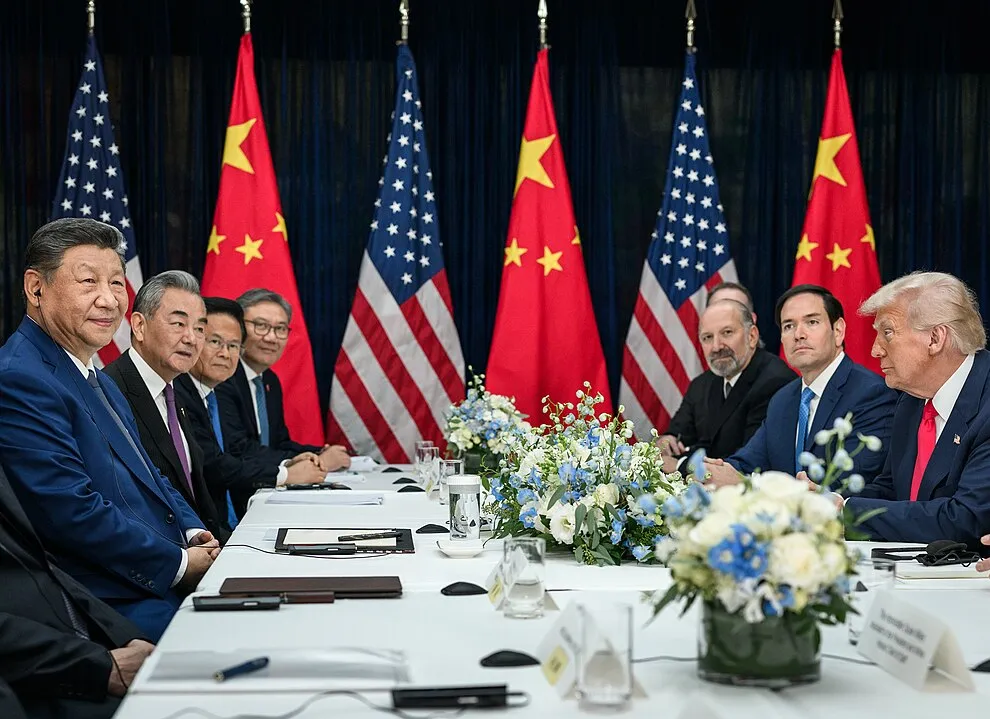
When the U.S. Supreme Court ruled that the International Emergency Economic Powers Act (IEEPA) does not authorize tariffs, it more than invalidated President Donald Trump’s favored tariff authority. The ruling triggered the need to rapidly rewrite the White House’s economic statecraft playbook.
The decision narrows unilateral presidential trade powers, constrains improvisational coercion, and shifts the terrain of U.S.-China competition away from executive brinkmanship to institutional process. Far from ending tariff confrontation with China, the ruling recalibrates how—and with what credibility—the United States can wage its trade wars.
The immediate legal implication is straightforward. Tariffs imposed under IEEPA authority—including Trump’s ten-percent “fentanyl emergency” tariffs on Chinese imports and the sweeping “reciprocal” tariffs that targeted dozens of trading partners—no longer rest on valid statutory ground. If a tariff’s legal basis was IEEPA alone, it is now unsustainable. For importers, that opens the possibility of large refund claims through the U.S. Court of International Trade. For the president, it removes one of the fastest tools in the executive arsenal: the ability to invoke emergency powers and immediately raise trade barriers.
Yet the structural architecture of U.S. tariffs on China remains largely intact. Duties imposed under Section 301 authorities dating back to 2018—still the backbone of U.S. tariff pressure on Chinese goods—remain untouched. National security tariffs under Section 232 also stand, as do anti-dumping and countervailing duties derived from Commerce Department investigations (such as the recently finalized 205 percent tariffs on Chinese active anode materials for batteries).
ongyuan Zoe Liu is Maurice R. Greenberg senior fellow for China studies at the Council on Foreign Relations (CFR). Her work focuses on international political economy, global financial markets, sovereign wealth funds, supply chains of critical minerals, development finance, emerging markets, energy and climate change policy, and East Asia-Middle East relations. Dr. Liu’s regional expertise is in East Asia, specifically China and Japan, and the Middle East, specifically Gulf Cooperation Council countries. Dr. Liu is the author of Can BRICS De-dollarize the Global Financial System? (Cambridge University Press) and Sovereign Funds: How the Communist Party of China Finances its Global Ambitions (Harvard University Press).
Prior to joining CFR, Dr. Liu was an instructional assistant professor at Texas A&M’s Bush School of Government and Public Service in Washington, DC, where she taught courses on global economy, economic statecraft, and Chinese foreign policy. She joined the Bush School after post-doctoral fellowships at the Columbia-Harvard “China and the World Program” and the Center for International Environment and Resource Policy at the Fletcher School at Tufts University.
Dr. Liu was a research fellow at the Edwin O. Reischauer Center for East Asian Studies and a research associate at the NYU Stern Center for Sustainable Business. She was also a visiting research fellow at the Institute for International Monetary Affairs in Tokyo, Bank of Mitsubishi-UFJ, and the Delma Institute in Abu Dhabi. She taught courses on Asian energy security and political risk analysis at the School of Advanced International Studies at Johns Hopkins University.
Dr. Liu received her PhD in international relations from Johns Hopkins University and her MA in international relations from the George Washington University Elliott School of International Studies. She received her BA in history from Shandong Normal University in Jinan, China. Dr. Liu is also a CFA charterholder.
Photo Credit: https://www.cfr.org/articles/how-the-supreme-court-tariff-decision-could-affect-trumps-china-negotiations