The Story Of Jack Downey, America’s Longest-Held Prisoner Of War, Comes To Light
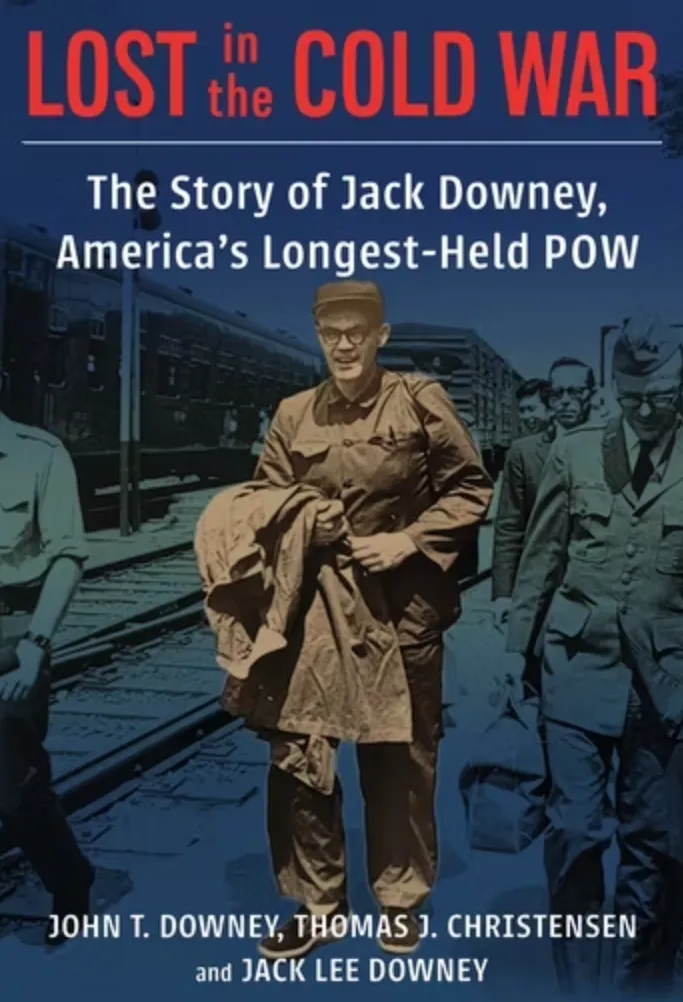
In 1952, John T. “Jack” Downey, a 23-year-old CIA officer from Connecticut, was shot down over Manchuria during the Korean War. The pilots died in the crash, but Downey and his partner, Richard Fecteau, were captured by the Chinese. For the next 20 years, they were harshly interrogated, put through show trials, held in solitary confinement, placed in reeducation camps, and toured around China as political pawns. Other prisoners of war came and went, but Downey and Fecteau’s release hinged on the U.S. acknowledging their status as CIA assets. Not until Nixon’s 1971 visit to China did Sino-American relations thaw enough to secure Fecteau’s release, also in 1971, and Downey’s in 1973.
Lost in the Cold War is the never-before-told story of Downey’s decades as a prisoner of war and the efforts to bring him home. His memoir—written in secret late in life—interweaves deprivation with humor and the absurdities of captivity. Through the eyes of his captors and during his tours around China, Downey witnessed the Great Leap Forward, the Cultural Revolution, and the drastic transformations of the Mao era.
In interspersed chapters, Thomas Christensen, the James T. Shotwell Professor of International Relations at Columbia SIPA, and an expert on Sino-American relations, explores the international politics of the Cold War, and tells the story of how Downey and Fecteau’s families, the CIA, the U.S. State Department, and successive presidential administrations worked to secure their release.
Christensen talks about the book with Columbia News, as well as how a page-turner allowed him to extend a recent trip to Norway, and the ideal guest list for his next dinner party.
How did this book come about?
After the hero of the book, Jack Downey, passed away, his family found a memoir that he had written in secret. He left a note saying that he wanted the memoir published at an academic press. The family contacted Stephen Wesley, an editor at Columbia University Press, where I edit a series of books, the Nancy Bernkopf Tucker and Warren I. Cohen series on America in Asia.
Stephen asked me to read the memoir for consideration for publication in the series. I found the memoir impressive and moving, but initially rejected it on the grounds that, on its own, it was not scholarly. I suggested that it be published at a trade press. I was then asked if I could think of any way to publish the memoir at Columbia, as this was Downey’s strong desire.
My solution: A diplomatic historian could write accompanying chapters inserted into the memoir to analyze the international and domestic context of Downey’s story. This would involve intensive research in Chinese and American primary and secondary sources, which would qualify the book for review at a refereed academic press. I offered Stephen and the Downey family a list of several diplomatic historians.
I am a political scientist and, though I have written books that involve a lot of historical work with archival materials, I did not include myself on the list of diplomatic historians. The family liked my solution, but they asked me to write the analytic chapters, and suggested that Downey’s son could write the afterword about his father’s life after his release by the Chinese. I had just started a different project, but I could not refuse after reading Downey’s memoir. Most important, when I explained the situation to my two children, they said that I had to say yes because I owed it to the hero and his family. So I did, and I am very glad I made that decision.
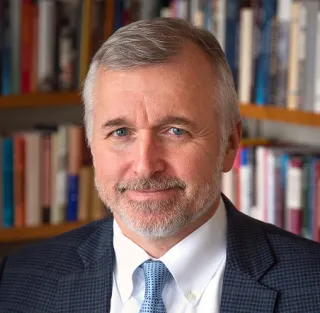
Professor Thomas Christensen explores the international politics of the Cold War and U.S.-China relations in a new book.
By Eve Glasberg October 18, 2022 - Read more here: https://news.columbia.edu/news/story-jack-downey-americas-longest-held-prisoner-war-comes-light
Thomas J. Christensen is the James T. Shotwell Professor of International Relations and Director of the China and the World Program at Columbia University. He arrived in 2018 from Princeton University where he was William P. Boswell Professor of World Politics of Peace and War, Director of the Princeton-Harvard China and the World Program, and faculty director of the Masters of Public Policy Program and the Truman Scholars Program. From 2006-2008 he served as Deputy Assistant Secretary of State for East Asian and Pacific Affairs with responsibility for relations with China, Taiwan, and Mongolia. His research and teaching focus on China’s foreign relations, the international relations of East Asia, and international security. His most recent book, The China Challenge: Shaping the Choices of a Rising Power (W.W. Norton) was an editors’ choice at the New York Times Book Review, a “Book of the Week” on CNN”s Fareed Zakaria GPS, and the Arthur Ross Book Award Silver Medalist at the Council on Foreign Relations. Professor Christensen has also taught at Cornell University and MIT. He received his B.A. with honors in History from Haverford College, M.A. in International Relations from the University of Pennsylvania, and Ph.D. in Political Science from Columbia University. He has served on the Board of Directors and the Executive Committee of the National Committee on U.S.-China Relations, as co-editor of the International History and Politics series at Princeton University Press, and as a member of the Academic Advisory Committee for the Schwarzman Scholars Program. He is currently the Chair of the Editorial Board of the Nancy B. Tucker and Warren I. Cohen Book Series on the United States in Asia at Columbia University Press. Professor Christensen is a life member of the Council on Foreign Relations and a Non-Resident Senior Scholar at the Brookings Institution. He was presented with a Distinguished Public Service Award by the United States Department of State.
Photo Credit: Columbia University Press - https://cup.columbia.edu/book/lost-in-the-cold-war/9780231199124