'Rocks vs. Chips' - by CWP alum Isaac Kardon
As the United States and China careen toward intensified economic decoupling and geopolitical rivalry, trends in the semiconductor and minerals sectors will define their strategic competition. Both great powers aim to consolidate competitive advantages by hampering the other’s technological development and hammering their trading partners. Both are doing so using increasingly damaging measures—but from opposite ends of tech supply chains. The American position remains strongest in advanced technologies, an edge that the Joe Biden administration sought to preserve and extend through an unprecedented series of export controls. China, meanwhile, is just beginning to implement a parallel export control regime that leverages its dominant market share in critical minerals as well as niche but strategic industries. The efficacy of both strategies will depend not only on each party’s execution, but also on their ability to sway middle countries toward cooperation.
Recent tit-for-tat actions mark a troubling new level of severity in this escalating struggle for technological advantage. On December 3, 2024, the People’s Republic of China (PRC) Ministry of Commerce (MOFCOM) imposed its first outright ban on the export of certain “dual-use” critical minerals to the United States. This export control went into force for germanium, gallium, superhard minerals like synthetic diamonds, and imposed additional licensing restrictions on graphite exports. In adopting this ambitious new measure, China was retaliating against U.S. semiconductor chip and manufacturing equipment export controls unveiled only the day prior. On February 4, 2025, in response to new U.S. tariffs on Chinese goods, MOFCOM announced restrictions on additional minerals including tungsten, tellurium, bismuth, indium, and products that include molybdenum. In initiating these outright bans, Beijing has aimed to mirror U.S. long-arm jurisdiction by, likewise, seeking to enforce its export controls extraterritorially in third countries, which could re-export the restricted goods to America.
by Isaac B. Kardon and Milo McBride
Published on February 14, 2025
Rocks vs. Chips: How the U.S.-China competition is playing out for high-tech advantage
Isaac B. Kardon, Ph.D., (孔适海博士) is a senior fellow for China studies at the Carnegie Endowment for International Peace. He is concurrently adjunct professor at Johns Hopkins SAIS, and was formerly assistant professor at the U.S. Naval War College (NWC), where he served as a research faculty member in the China Maritime Studies Institute.
Isaac’s research centers on the People’s Republic of China’s maritime power, with specialization in maritime disputes and the international law of the sea, Chinese global port development, China-Pakistan relations, and the People’s Liberation Army’s overseas basing. His writing appears in International Security, Security Studies, Foreign Affairs, the New York Times, the Naval War College Review, as well as other scholarly and policy publications. Isaac’s book, China’s Law of the Sea: The New Rules of Maritime Order (Yale, 2023) analyzes whether and how China is “making the rules” of regional and global order.
At Carnegie, Isaac is building on his foundation of research on China in the maritime domain to explore China’s role in the wider global commons. High seas, deep seabed, polar regions, and orbital space are among the “strategic frontier issues” prioritized by China’s leadership—and thus key sites to observe China’s interests in and influence on vital global rules, norms, and standards. China’s interest in leading the nascent regime for deep sea mining is a particular area of research focus. He is also continuing “past the pier” on his existing stream of research on PRC ports to further study China’s development of transport and communications infrastructure networks with dual civilian and military functions.
Isaac earned a Ph.D. in government from Cornell University, an M.Phil in modern Chinese studies from Oxford University, and a B.A. in history from Dartmouth College. He was a China & the World post-doctoral fellow at Princeton University, and has held visiting appointments at NYU School of Law, Academia Sinica, and the PRC National Institute for South China Sea Studies. He studied Chinese (Mandarin) at Peking University, Tsinghua University, Hainan University, and National Taiwan Normal University.
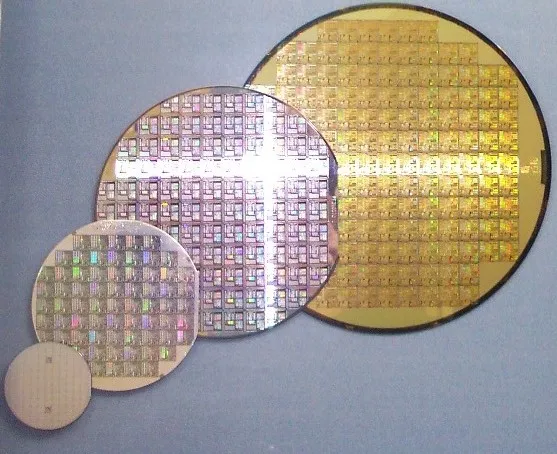
Photo Credit: By German Wikipediabiatch, original upload 7. Okt 2004 by Stahlkocher de:Bild:Wafer 2 Zoll bis 8 Zoll.jpg, CC BY-SA 3.0, https://commons.wikimedia.org/w/index.php?curid=928106