"Critical Conditions: An Operating Framework for Allied Economic Statecraft" - by CWP alum Eyck Freymann
Allied governments call too many things “critical,” spreading scarce resources thin and working at cross-purposes. This paper offers a four-layer rubric—encompassing geographic mapping, direct dependency, indirect dependency, and adaptive capacity—that allied policymakers can use to systematically identify which economic dependencies on China actually warrant intervention and which can wait. Three illustrative case studies, on gallium, LOGINK, and copper, demonstrate the rubric in operation.
Key Takeaways
- If everything is critical, nothing is. The current policy conversation around US coordination with its allies conflates real strategic vulnerabilities with ordinary commercial dependencies. It also wastes taxpayer money and gives no agency political cover to deprioritize anything. Allied governments need a shared, disciplined methodology for ranking dependencies, with “high criticality” treated as exceptional.
- Criticality has four layers, and all must be assessed together. Beyond geographic concentration, the proposed rubric requires policymakers to evaluate direct dependency risks (technological subordination and monopoly power), indirect risks (coercion, capacity, sabotage of third-country suppliers), and the adaptive capacity of the United States, allies, and the broader market.
- Autarky, or complete self-sufficiency, is almost always the wrong answer. The more of the global economy that mobilizes to dilute an adversary's leverage, the lower the economic cost and the greater the geopolitical benefits of doing so. Neutral countries, representing roughly a third of global GDP, must be included; “friend-shoring” risks becoming a euphemism for command-and-control industrial policy.
- Some dependencies, like Chinese control of global logistics data through LOGINK, amplify adversary leverage across many other sectors. Therefore, cross-domain enablers deserve special priority.
- The rubric is built to scale through automation. Its structured questions are machine-readable, allowing AI to screen tens of thousands of products and inbound proposals while human analysts focus on cases flagged as “high criticality” or “uncertain.” This makes the framework operationally usable inside resource-constrained agencies.
Eyck Freymann is a Hoover Fellow at Stanford University, where he directs the Allied Coordination Working Group. He is also a Non-Resident Research Fellow at Columbia University's Center on Global Energy Policy, the Institute of Geoeconomics in Tokyo, and the China Maritime Studies Institute at the U.S. Naval War College.
Dr. Freymann works on strategies to preserve peace and protect U.S. interests and values in an era of systemic competition with China. He is the author of several books, including the forthcoming Defending Taiwan: A Strategy to Prevent War with China (Oxford, 2026), The Arsenal of Democracy: Technology, Industry, and Deterrence in an Age of Hard Choices (Hoover, 2025), and One Belt One Road: Chinese Power Meets the World (Harvard, 2021). His scholarly work has appeared in The China Quarterly and is forthcoming in International Security.
Dr. Freymann comments on bipartisan national security issues in The Wall Street Journal, The New York Times, Foreign Affairs, The Economist, War on the Rocks, The Wire China, and The Atlantic, among other venues.
Before Hoover, Dr. Freymann held postdoctoral fellowships at Harvard and Columbia. He holds a doctorate from Oxford, masters degrees from Cambridge and Harvard, and a bachelors from Harvard, all in history and China studies.
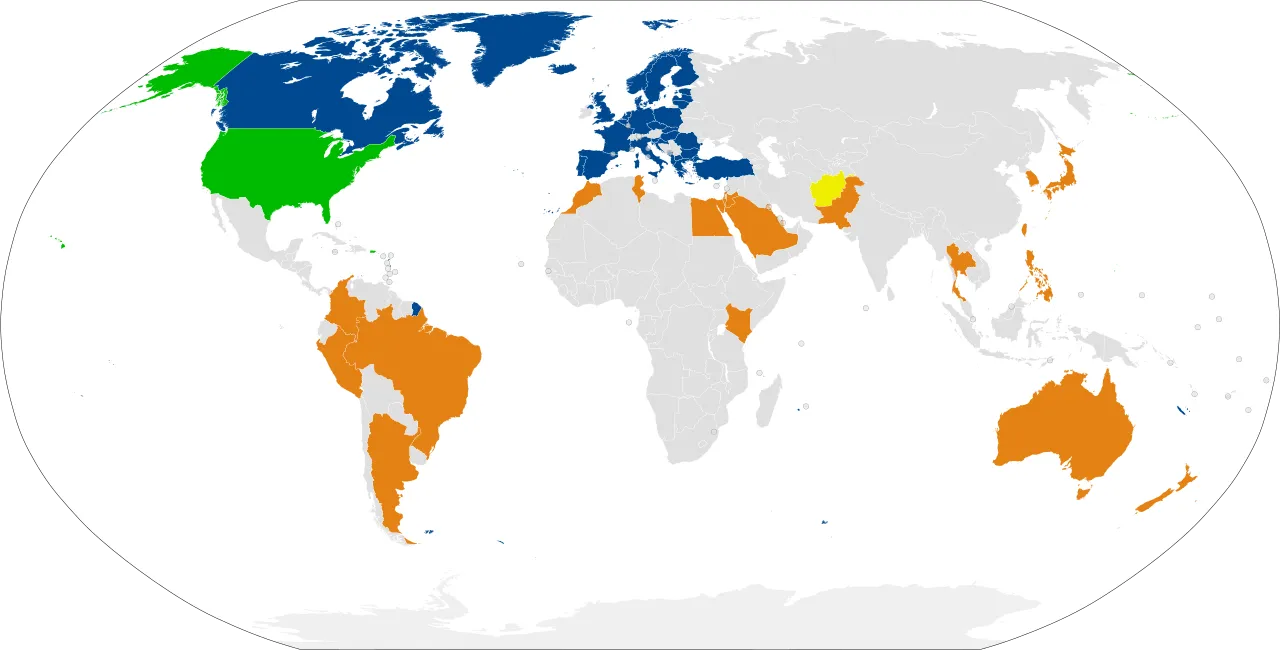
Photo Credit: Major non-NATO and NATO allies of the United States, the former as designated by U.S. law. United States Major Non-NATO Allies NATO allies - By Ratatosk - Own work based on: BlankMap-World6.svg, CC BY-SA 4.0, https://commons.wikimedia.org/w/index.php?curid=4281852