"China’s Historical Statecraft: The Construction of Lost Territories in Bolshoy Ussuriysky Island, Taiwan, and the South China Sea" - by CWP alum Christina Lai
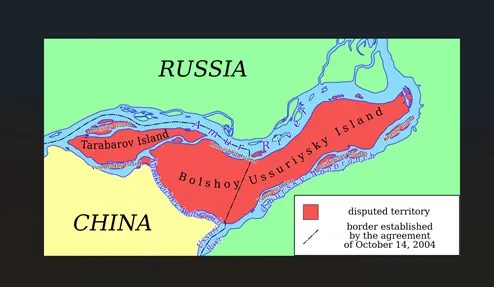
Since the 2010s, China has been increasingly assertive in its sovereignty claims over Taiwan and the disputed islands in the South China Sea (hereafter SCS). Specifically, the Chinese Communist Party (CCP) legitimizes its ownership of these two places based on the glory of China’s imperial past, shared Confucian traditions between the Chinese and Taiwanese people, and the humiliation of its colonial subjugation. Meanwhile, Beijing has been reticent about its northeastern territory ceded to Russia, as it aims to maintain stable bilateral relations. China’s official narrative and foreign policy behaviour pose the following empirical puzzles: How does the Chinese government invoke feelings of glory and humiliation (or lack thereof) in constructing its claim over what it views as its indivisible territory? What role does Beijing’s use of history play in forging its great power identity? This study advocates a long-term perspective on how political actors represent territory in ways that are indivisible, thereby providing insights into China’s grand strategy, foreign policy posture, and its view on territorial integrity. The organization of this article is as follows. First, it engages the current literature on constructivism, territorial disputes, and Chinese foreign policy. It then proposes a framework of historical statecraft for understanding how the CCP institutionalizes the nation’s past with an official narrative of glory and humiliation. Second, it unpacks the notion of indivisible territories in China’s narrative, and it examines official statements from the country’s top leadership, high-level diplomats, and government officials, showing how indivisibility is a socially constructed process. Third, this study provides a structured comparison of Bolshoy Ussuriysky Island, Taiwan, and the SCS. Finally, it concludes with thoughts on the direction of future research on foreign policy analysis and offers policy implications for countries in Asia and beyond.
Author: Lai, Christina
Source: Pacific Affairs
Publisher: Pacific Affairs, a division of the University of British Columbia
DOI: https://doi.org/10.5509/2025982-art3
https://www.ingentaconnect.com/content/paaf/paaf/pre-prints/content-pacaff-98.2-art3
Christina Lai is an associate research fellow in the Institute of Political Science at Academia Sinica, Taiwan. She is interested in U.S.-China Relations, Chinese Foreign Policy, East Asian politics, and Qualitative Research Methods. Her works have appeared in the Politics, International Politics, Political Science, Journal of Contemporary China, Pacific Review, International Relations of the Asia-Pacific, Asian Survey, and Asian Security.
Photo Credit: By Insider - Own work, CC BY-SA 3.0, https://commons.wikimedia.org/w/index.php?curid=12267766