
"China is Trying to Have it Both Ways in the Middle East" - by CWP alum Isaac Kardon
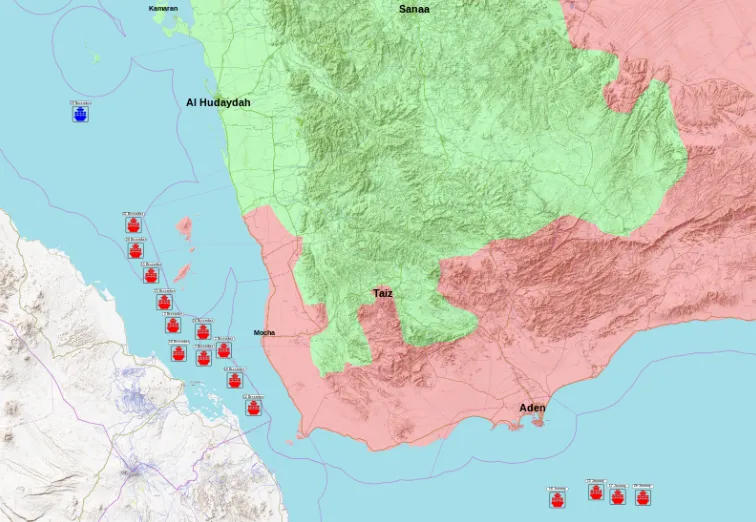
There has been plenty of hand-wringing in the West about the prospect of China displacing — or at least rivaling — the United States as the world’s leading superpower. But the evolving security crisis in the Red Sea makes clear that this remains a distant prospect.
China, with a trade-led economy dependent on the free flow of commerce through chokepoints like the Bab el-Mandeb strait off Yemen, relies on the United States to protect international sea lanes. The U.S.-led military response to the Houthi militia attacks on international shipping may not ultimately be the answer to the current crisis — the Houthis, so far, appear undeterred — but the United States has at least demonstrated a clear commitment to keeping open vital trade routes that connect China to the Middle East and Europe.
Rather than acting like the global leader it purports to be, China has made no appreciable move to shoulder the costs or risks of ensuring security in the Red Sea, despite having its sole declared overseas military base in Djibouti, adjacent to the strait. Nor has it publicly offered a viable alternative to America’s actions. Instead, it seems content to largely sit back and offer veiled criticism of the U.S. military response.
https://www.nytimes.com/2024/01/26/opinion/china-redsea-houthi-shipping.html - Jan. 26, 2024
Isaac B. Kardon, Ph.D., (孔适海博士) is a senior fellow for China studies at the Carnegie Endowment for International Peace. He is concurrently adjunct professor at Johns Hopkins SAIS, and was formerly assistant professor at the U.S. Naval War College (NWC), where he served as a research faculty member in the China Maritime Studies Institute.
Isaac’s research centers on the People’s Republic of China’s maritime power, with specialization in maritime disputes and the international law of the sea, PRC global port development, PLA overseas basing, and China-Pakistan relations. His writing appears in International Security, Security Studies, Foreign Affairs, the Naval War College Review, as well as other scholarly and policy publications. Isaac’s book, China’s Law of the Sea: The New Rules of Maritime Order (Yale, 2023) analyzes whether and how China is “making the rules” of regional and global order.
At Carnegie, Isaac is building on his foundation of research on China in the maritime domain to explore China’s role in the wider global commons. High seas, deep seabed, polar regions, and orbital space are among the “strategic frontier issues” prioritized by China’s leadership—and thus key sites to observe China’s interests in and influence on vital global rules, norms, and standards. China’s interest in leading the nascent regime for deep sea mining is a particular area of research focus. He is also continuing “past the pier” on his existing stream of research on PRC ports to further study China’s development of transport and communications infrastructure networks with dual civilian and military functions.
Photo Credit: By Ecrusized - Own work. Data derived from Timeline of the Red Sea Theater of the 2023 Israel-Hamas War. Control of Yemen citing yemen.liveuamap.com. Made using OpenTopoMap data., CC0, https://commons.wikimedia.org/w/index.php?curid=141722415